Do you prefer walking on two legs or four?
Four legs. Easily. Walking on two legs is something I’ve learned for the sake of fitting in with and easier participation in human society. After almost twenty years of practice it’s become just as simple and automatic to me as it is to you, and even still it could never come anywhere close to the grace and bodily dexterity of quadrupedal movement. I just feel more... myself as a quadrupedal creature. No one’s ever surprised to hear that. What many don’t realize is that it put me far ahead of my peers when it came to movement and coordination, and in turn, mental and physical development.
Kittens become agile at a young age, and I was certainly no exception; by the time I was about 20 months old, I was running from one end of the room to the other in a couple seconds, and climbing up to wherever I wanted in the event it was too high for me to effortlessly jump onto, like I would a table or an adults arms. Quite the stark contrast to my human peers, who could hardly walk from point A to point B without stumbling, or falling, or both in that order. My advanced movement at a young age meant my exploration of the world was deeper and richer than what others would experience for years— if ever—allowing me in advance special access to new mistakes and lessons. However, a side effect of this was that my peers quickly became my inferiors.
This story is always a little different depending on who exactly the storyteller is, but here’s what I remember from, uh, watching the camera footage:
I had either just turned two or was about to when I was really curious to try one of the teachers special push-pops; I can’t taste sweetness at all, but the push-pop Miss Jean had in her purse looked unusually pretty and she’d snack on it every now and then in class. So playtime comes around and, through unconscious muscle memory, she sets her purse where human children can’t get it, which I take notice to. I also notice when she soon walks off to settle a petty dispute. As she explains to Ronda that just because purple is her favorite color doesn’t mean the purple crayons are hers, I’m perched on the bookshelf fishing through the little compartment she always puts it in, and by the time she turns back, I’ve long located my prize and trotted away into some little hidey hold I’ve found for myself. I remain there for several minutes until she goes to grab something from her—now that she’s looking at it—clearly tampered with purse, and her expression visibly morphs over several seconds from huh to oh shit to fuck me!
“Citizen...!”
She catches herself searching for a full name to call me by, which I have none, and so repeats herself with more certainty.
“Mister Citizen! Come here now!”
She doesn’t think to look through her purse to see what I’ve taken, nor does she need to; it’s all over my face, my sleeves, and my front paws which are now leaving little velvet tracks on the carpet. She barks at me to stand still, and as she lifts me off the ground I loudly and shamelessly proclaim:
“Miss Jean, this is nasty!”
“...yeah.”
“Why you eat this?”
“I don’t.”
“Yeah. Nasty push-pop.”
“Push... pop? Sweetie this is lipstick.”
“Oh... whats listic?”
At least, that’s what she told me I said last time I saw her. And that’s not even the really funny part!
Sometime later, my caregivers got the idea to set that exact brand of lipstick somewhere only I could reach during the next playtime. Just to see what I’d do. They wanted this experiment to be pure, so to ensure as little adult interference as possible they created a special playtime room with basically nothing for kids to kill themselves with. I could sense that something was different as soon as I walked in, and after a minute or two of investigating, I spotted the forbidden push-pop on top of a bookshelf that was rooted in the wall to ensure it wouldn’t topple over. Now, I knew it tasted gross but I also knew I wasn’t supposed to have it, so I wanted to do something with it. I passively painted my surroundings with it for a minute, being careful not to get any on myself. A few of the other kids walked up to the bookshelf asking what I was doing. I didn’t answer. One of them made the very astute observation: He painting push-pop! And you can really see my thought process on my face in that moment. It’s not a push-pop, stupid.
...Or is it?
I immediately hop onto the ground and scurry off to find some kid minding their own business. I found my victim quickly: this boy playing with a toy monster truck, lost in his own little world until I sat across from him.
“Hi kitty.”
“Hi.”
He watches as I take the lid off my push-pop and start licking it gently.
“Mmm!”
He continues watching me, now with a wanting look in his eyes. He didn’t get any candy! How unfair.
“You want some?” And he does. “Take a big bite, just for you!” And he does.
Ever seen a cat laughing his ass off?
So yes, being on four legs has always worked really well for me. Walking on my hind legs... works... although it didn’t really for a long time. My body simply isn’t built for bipedal movement, but human civilization is. I didn’t have much of a choice.
In my case, the ability to stand and walk shoulder to shoulder with the rest of society is comparable to speaking a second language; the inability to do it certainly wouldn’t be a disability, and I would still be more than capable of being a fully functioning member of society, but I would miss out on all kinds of amazing social opportunities. Fitting into society’s bipedal flow, even if only for a little while each day, would help me belong just that much more. Specifically, I had to master standing upright supported only by my own legs and back, lest I only be able to do so by holding onto something close by, which would be better than nothing, but problematic in the event that I had nothing (or no one) to hold onto, or needed to use both my hands for something else. Learning to do it without major assistance or setbacks, just like everybody else, was the obvious choice.
Now, if you want to train your body for something it wasn’t built for, starting young while its in its early stages of development is your best bet. The thing is, very young children are prone to complacency, right? Pushing the body to its limits as a regular ritual is a lifestyle typically lived by adults who are their own masters, rather than children who lack the willpower and discipline for such a commitment, especially if it’s biologically unnatural. So you can imagine how shitty my attitude was toward practicing walking upright at least three times a week in physical therapy. Although physical therapy isn’t quite the right term for it... my body wasn’t relearning a function it lost to an injury, but was pushed to achieve something it was never meant for in the first place. Being well aware of the hurdles I’d face, my caregivers fervently hoped I would naturally want to walk on my hind legs for the sake of fitting in with everyone else. Monkey see, Monkey do, right? Unfortunately for them, Kitty did not do. Kitty had his own ideas.
Not only did being naturally short as a child mean I lacked the reference level to understand why the inability to walk upright would be problematic as an adult, and not only did my advanced mobility allow me to get to wherever I needed whenever I wanted, but my cuteness automatically manipulated adults into letting me get away with things even their own children never could! Why learn to walk upright when I was already set? Because I wouldn’t be small forever? And? The future doesn’t exist to a five-year-old child living relentlessly in the moment, you know.
For starters, returning to the topic of standing upright by holding onto something for support, that’s one thing I did a lot of the time. For example, if I were at a table with some other kids, I’d have my back legs on the ground and my fronts on the table. Most of the time we’d have chairs, so I’d be able to sit up and freely use my hands, but every so often I’d have to support myself with at least one of my hands if I wanted to see eye-to-eye with the others. No, Citizen! A few teachers who actually cared would get onto me for it sometimes. Hind legs and back only, remember? They were the ones I always tried to avoid. Without tables, I would either hold on to a wall or allow my body to lean against it, assuming I hadn’t already wrapped myself around a friend, which doubled as a form of physical affection and a mode of bipedal movement.
If I didn’t feel like holding onto anything? That was fine. I was always pretty good at making people come down to where I was. Which scene looks more natural in your head: children hanging out on the floor, or adults hanging out on the floor? Right. Kids aren’t so frightened of being gross and being perceived as gross like adults are taught to be, and they’re already so close to the ground anyway. Besides, that’s where I was a lot of the time! I have lots of fond memories of parking somewhere on the ground and other kids slowly collecting around me. It was one of the few times when I could move completely naturally and still be on everyone’s level. I look back on it fondly.
Whenever I was alone, while the floor indoors rarely has much to offer, lying on the ground outside is a uniquely liberating sensation that I wish more people appreciated. It’s always been lovely, feeling the blades of grass caress your skin, the ticklish sensation of bugs crawling on your body, the warm embrace of the sun or the cool protection of the shade, and the smells... God, I could write a whole book about all the smells. You feel less like a human and more like... well, just like any other random creature that lives outside. It’s a kind of ego death. And sure, you end up rolling in shit every now and again, but life is all about tradeoffs isn’t it? You’d think more adults would make peace with that, but no... they were always up my ass about something. Suddenly a bunch of adults who eat more cholesterol than protein and drink more beer than water were barking at me to get off the ground, because it’s “Unclean.”
...okay.
Another thing people would let me get away with was hopping on top of my surroundings to speak with them! There’s usually nothing unnatural about the image of cats hopping onto desks, tables, benches, windowsills, or what have you, either just to hang out there or to say hi to a human. Pair this with other little things like my cute outfits and barrage of questions, and you can see why, say, a receptionist wouldn’t be quick to shoo me off their desk. Hopping up to these spots in half a second certainly helped since people didn’t really have time to process it before I was in their face. It makes me wonder: generally, we don’t want our kids walking on tables for reasons like the risk of falling and how gross the bottom of their shoes are, right? Well, in my case, the former was never a concern, and people tended to forget all about the latter... would we care about kids on tables if they could jump up and down them as effortlessly as I could? Well, okay, could... I still can, but it wouldn’t be cute now that I’m, like, two-hundred pounds. That reminds me, funny story...
Out of all the reasons I eventually got serious about learning to walk on my hind legs (and there were many) this story was a more formative experience that really opened my eyes at the time: I had this one friend, right? The outside of the window in his room had this big fat windowsill, and whenever I was hanging out at his place and ran some kind of errand, I would exit out of and come in through said window. One day, I returned to this spot to find him sitting right there in his room, giddy with excitement to tell me about something that happened while I was away, and as I’m sitting on the windowsill listening to him, we suddenly notice this weird noise, which I didn’t realize was the sound of wood breaking. Do you hear that? I asked him. We’re both super quiet, trying to hear where this noise is coming from, when RRRIP! The whole entire thing just gives and I come crashing down with it. Most of the time, I land on my feet. I didn’t that day. His room was on the ground floor, thank God. I had camped out on plenty of windowsills that were way higher up and way less sturdy.
You can try and talk some sense into kids all you please, but they typically only learn the hard way through their own personal experiences. People were always reminding me of how I was getting bigger and bigger, but it was happening too gradually for me to really notice or care. That day, I noticed and cared. They’d been training me to walk upright for years, but it wasn’t until I was seven that I started putting in the effort to apply what I learned in those sessions to my daily life.
—————
My spine lacked the proper lumbar lordosis to properly support walking upright; my arms weren’t able to swing as wide as what is ideal for keeping balance; my core was longer and my legs were shorter than a human’s; my feet were shorter with less surface area to distribute my weight across. Walking upright all the time would never be possible, but doing it for a little while each day whenever necessary or appropriate was achievable if I tried hard enough.
The first major challenge was building strength in my back legs; using all four legs to carry my weight meant I had above average upper body strength but below average lower body strength.
Starting when I was eight months old, they would put me in jumperoos bereft of fun distractions like noisy buttons and levers to help get me used to the feeling of supporting myself with my hind legs, eventually putting a treadmill underneath me to give me a head start in learning the muscle memory for walking, or gait training as it’s commonly referred to in the medical field. By the time I was about sixteen months old, the simple jumperoo had been replaced with rehab rails (ceiling mounted rail systems that support patients in a jumperoo-like sling while allowing them to move across the room), and not just any rehab rail at that; typical rails are directionally rigid, allowing patients to walk only where the rail is and follow only where the rail goes, which is almost always in a straight line. Such constraints would hinder my growth in the long run since I was learning how to walk on two legs rather than relearning.
And so, beginning around this time, most of my gait training took place in what I like to call sling rooms, where the entire ceiling was a dedicated omni-directional rehab rail system, allowing me free movement and more complex walking cycles. But the advancements don’t end there: because a traditional rail system is essentially a pulley, it is necessary for walking patients to be attended to by a therapist, rope in hand, ensuring enough support is being provided, and appropriately increasing or decreasing support during elevation changes. Ignoring the fact that this constant supervision would become tedious during sessions that went on for at least one full hour, it’s really only possible to do with injured patients moving slowly and decisively; doing it manually with a perfectly healthy child moving as fast as his little legs will take him would mean constantly making split second changes in effort to ensure appropriate support. The obvious solution was to install a Full Body Tracking system that automatically configured support based on my elevation and what my body was doing.
I was five-years-old when my hind legs could finally support my body on their own. Now, my body needed to learn how to support itself. Remember how long my core is and how short my hind legs are? Second major challenge: keeping balance while walking.
By this time, the sling had been retired. I had gotten good enough at standing in place that on a good day I was able to stretch downwards to touch my toes and upwards to touch the sky with little difficulty; perfectly tolerable, to put it simply. But walking...? It was walking that I absolutely hated. You know times when you’ve moved in unnatural ways like walking on all fours or hopping on one leg, and it wasn’t pleasant but wasn’t terrible either? Because you stopped? Well, I was denied that luxury. It too would be perfectly tolerable now that pushing my body to its absolute limits is a ritual I’m intimately familiar with, but at five years old? It was a little hellish if I’m being honest... I’d begin stepping forward and try to control my body’s wobbling as much as possible before falling to the ground, usually within ten to fifteen seconds. It’s okay to fall, Citi, an assistant told me once, when their hypothesis that it would be long before I gained proper control was quickly being proven correct, Walking is basically a series of controlled falls. I know he meant well in giving me a deeper understanding of my training, but all it really accomplished was teaching me this: whatever my legs were doing, it certainly wasn’t walking.
At the start, they’d let me practice with assistive walking devices like canes and crutches so I could learn just a little bit more muscle memory, but once I got good with them, I overheard them talk about only using them as warm ups for walking without them. Upon realizing this, I suddenly began struggling with them again. Allegedly. Of course, small children are rarely good liars (or actors...) and it didn’t take long to identify subtle cues in my movement that revealed the truth. These people had worked with injured patients for longer than I’d been alive, and they were intimately familiar with what struggle looked and sounded like, to such a degree that they’d receive anonymous tip-offs from their subconscious whenever something wasn’t right. As it was, I got to warm up with a cane for five minutes before training really began. I treasured those five minutes.
In all honesty, the story of my training from here on out isn’t terribly interesting or convoluted since balance was really the last obstacle I had to overcome; I continued practicing. I continued hating it. I continued showing up for it anyway.
I’m beyond grateful to have always had adult role models by my side pushing me in the right direction; progress is often slow, which makes it hard to show up day after day when you’re young and impatient. But noticing small changes in my body was by far one of the most validating sensations of my childhood, and is a feeling I often rekindle in the training I withstand today; by age seven, I was able to walk upright for three minutes straight. By eight, I had pushed it to five minutes. By nine, not only had I achieved eleven minutes, but I was perfectly able to do it whenever it felt appropriate in my daily life. By ten, it looked perfectly natural, and by eleven it felt perfectly natural. It was then that me and my team agreed training would no longer be strictly necessary, on the basis that as long as I walked upright often enough for the next few years of sensitive brain development, the habit would stick with me for life. Of course, if I felt my two-legged gait was lacking or falling behind, I was always welcome to return to training. So far, that hasn’t happened.
Most people don’t realize how lucky they are to stand on their feet until it hurts them to do so as they get older, if they ever get to stand in the first place. When people casually remark about how cool it is that I can walk on my hind legs, or jokingly ask why their cat can’t, I don’t think they understand how much of a story there is behind my gait. I could easily write twenty more pages about my gait training journey, but I think this section is long enough as it is.
—————
So since you’ve got greater movement ability than us, how do you like to get around?
Having an extra two legs carrying my weight and propelling myself forward allows me to walk as fast as you jog, which is an average of 7 mph. And that’s just casual walking; whenever I’m actually trying to get somewhere, I tend to enter this sport mode mindset where everything except my destination and immediate surroundings gets blurred out by my flow state. Not to imply picking up the pace takes effort. For me, a 10 mph trot is nothing more than a hurried walk that expends little energy since my legs don’t have to carry as much weight. I feel this bears repeating: I can move at ten miles per hour without getting tired. Four legs is invigorating! I feel weightless whenever I’m in sport mode, like a paper airplane being pushed along by the wind. And I still manage to be late for everything.
-Increased speed
-Reduced fatigue
Next on the list, agility.
Keeping balance on four legs is too easy! What sounds more efficient: two guys carrying a couch horizontally or four guys carrying a couch vertically? It doesn’t even consciously register whenever I slip or trip anymore. One time I ripped a plug out of the wall tripping over its wire, and the act of catching myself was so effortless and automatic that I actually plugged it back in and started walking away before thinking to myself “Hey, I just tripped.”
Of course, one downside of Quadrupedal movement is that my hands double as my feet, meaning they often go straight from the ground to... your stuff. Yuck, right? Well, most people don’t mention it; either they don’t realize this since they’re not used to thinking about four-legged creatures this way, or they bite their tongue out of politeness, assuming it would be rude in a cultural sense, like asking an Indian not to eat with their hands. (Even if they don’t see it that way, a lot of the time there’s something just too absurd about asking the jaguar-person to wash his hands to even bother) The people who do take notice, and do say something... they don’t care for that shit at all.
Where I live, we have lot’s of very... scientifically literate minds. I’ve noticed that half of these people conduct their lives as if germs are only a social construct, and the other half act like germs are fully grown adults that gang up on them to try and spit in their mouth. Which is to say, the people that do care, care immensely. When I know in advance that I’m gonna be around these people, I have to put on these fancy gloves for whenever my front paws go from hands to feet. They’re super easy to get on and off, so I really can’t complain about it... except I can complain about whatever the hell I please; the fact that I’m only doing it to make others more comfortable just annoys me. It makes me want to take a four-legged stroll through a barnyard and then type out an essay on their personal laptop immediately afterwards.
Besides, I have my nose! I can smell if I get something really bad on my hands. If you have so much as a half decent immune system, most of the crap on the floor wouldn’t hurt you if you swallowed it in a capsule! But no. The blind can’t see danger, the deaf can’t hear danger, and you can’t smell danger like I can, so as far as you’re concerned, anything could be dangerous. And if you fit the description of germaphobe, you can take comfort in knowing that I’ll never again forget to take off my walking gloves when I’m done with them. Not after that day...
I’d had an early start after a late night, and I was practically sleepwalking on my way to do some Deep Scent Analysis at a microbiology center, meaning I got to make the trip with my stupid fucking gloves on. I hadn’t realized my left glove had picked up a nice hearty piece of gum until it got sandwiched in between me and the director's handshake in the lobby. In my half asleep panic, I tried to improve the situation by impressing her and noting that I could smell it was sugar free! But she must’ve been gagging too loudly to hear me as she furiously scrubbed it off her hand, hard enough to leave a patch of skin red afterwards. Or maybe that was just the coloring from the gum... She wouldn’t let me smell it to find out.
To this very day, whenever we run into each other, she calls me Gumshoe.
—————
While it’s true that the ways I get around are often unconventional, they really don’t hold a candle to some of the crazy fantasies you guys come up with! To be frank, most outlandish fictional fantasies are thought up during childhood, and often don’t evolve afterwards since we have no genuine experience to learn from. For example, many people (usually young but some older) will ask if, or even assume that, I get from point A to point B by climbing up and down buildings effortlessly using its windowsills as hand-holds, and leaping from rooftop to rooftop like a ninja. Y’know, so I don’t have to deal with crowds! But let’s actually think about this for a second; when do we see characters doing that in fiction? At night? On a secret mission? Hiding where people rarely look because they’re on the run? Or... because they’re running late for work after sleeping through their alarm? I hate to be such a dick about this, but do people really have to try that themselves to see how intensely inconvenient that would be?
Besides, ignoring the fact that it’s also highly illegal, I’ve got way too much meat on my bones to be hopping on top of stuff all willy-nilly like that. Most people hear the word cat and think to themselves, “Oh, a natural born climber!” which is absolutely true! But then they apply that mentality to architecture that wasn’t built with climbing in mind. So the image of me chilling on top of a canopy or an overhang may seem cool at first, but when you take into consideration the fact that I’m about 240lbs (Wild jaguars who don’t count their calories or hit the gym can already get pretty heavy) it quickly becomes clear why that might be an awful idea. With that in mind, I would never hop on top of something with people underneath it unless I’m 100% positive it can handle my weight. You people often assume that having the ability to hop up anywhere I want means I get to just do it whenever I please, but that’s not the case when you're sharing a space with other adults.
With all that being said.... I do enjoy urban climbing in small doses. I’ve been fascinated with it, ever since this one day when I was six: I was on the run, trying to escape the feds (my caretakers) and climbed up onto the roof of, oh I don’t know, some bakery I just happened to find myself at? I think it was the excitement of conquering my environment with a few split-second decisions along with the simple joy of mischievousness that made me want to continue scaling buildings, much to the annoyance of my caretakers who continued pouring massive resources into elaborate indoor arenas built specifically for honing my climbing abilities. And I’ve always loved and cherished them, of course! (Matter of fact, as I type this out my arms are a bit sore from pushing myself pretty hard at one the other day) But the desire to climb buildings was always an itch I was forbidden from scratching until recently. It’s not that one is necessarily better than the other... It’s too apples vs oranges to compare directly; I got to savor some of the finest apples a man could enjoy, but damn did I want to sink my teeth into an orange that may or may not injure or kill me.
I only get to urban climb under special circumstances. These special circumstances, for your information, are almost always payment for assisting with a corporate entity’s research somehow, usually by conducting Deep Scent Analysis. I began requesting the right to urban climb from said entity as payment several years back when I turned eighteen. They were unanimously apprehensive, some rejecting the request without a second thought on the basis that their concern for my safety couldn’t be ignored. (Translation: if I die, they can’t use me anymore.)
Convincing several powerful people to do something highly irresponsible didn’t happen overnight, but after walking out of a few projects over it, along with establishing a good express contract or two ensuring no one would be held liable in the event of an injury, a few owners here and there reluctantly gave me legal permission to scale their buildings during scheduled time blocks (to ensure occupants were aware I would be there).
Climbing to the top of any building was strictly forbidden during my childhood and early teenage years, which often didn’t stop me from scaling one or two stories anyway out of naughtiness and excitement. Sadly, as I grew bigger and stronger, this excitement faded as jumping onto the ground from the top of a single story building gradually became about as exhilarating as jumping out of bed. By the time I was twelve, I did it purely out of the joy of keeping bitches mad. But the excitement wasn’t there. The danger wasn’t there. I got the privilege of tasting that excitement once again the first time I scaled all eight stories of the Human Movement Research Center! Funny story, I requested that management warn all the employees ahead of time not to stare, but I guess the sixth floor never got the memo? It’s difficult to focus on my breathing and grip and everything when thirty people are giving me that thousand yard stare like they’ve never seen a jaguar climb a building before.
I don’t get to do it often, and honestly? I wouldn’t want to. It’s just something I treat myself with here and there to let my inner child come out and play for a bit.
—————
When you’re on all fours, do people usually see you below them? Doesn’t anyone trip over you?
It’s reasonable to assume that me being so low to the ground would make it hard not to trip over me, especially if you live with animals that make a habit of hanging out near your feet or following you around. Some poor soul does topple over me here and there, typically someone who’s running at top speed trying to get where they’re going, or a drunkard. I’ve always helped them back up and apologized profusely—occasionally going as far as buying some bar hoppers a round of drinks—even though it’s entirely their own fault.
Honestly, how did you not see a jaguar in the street?
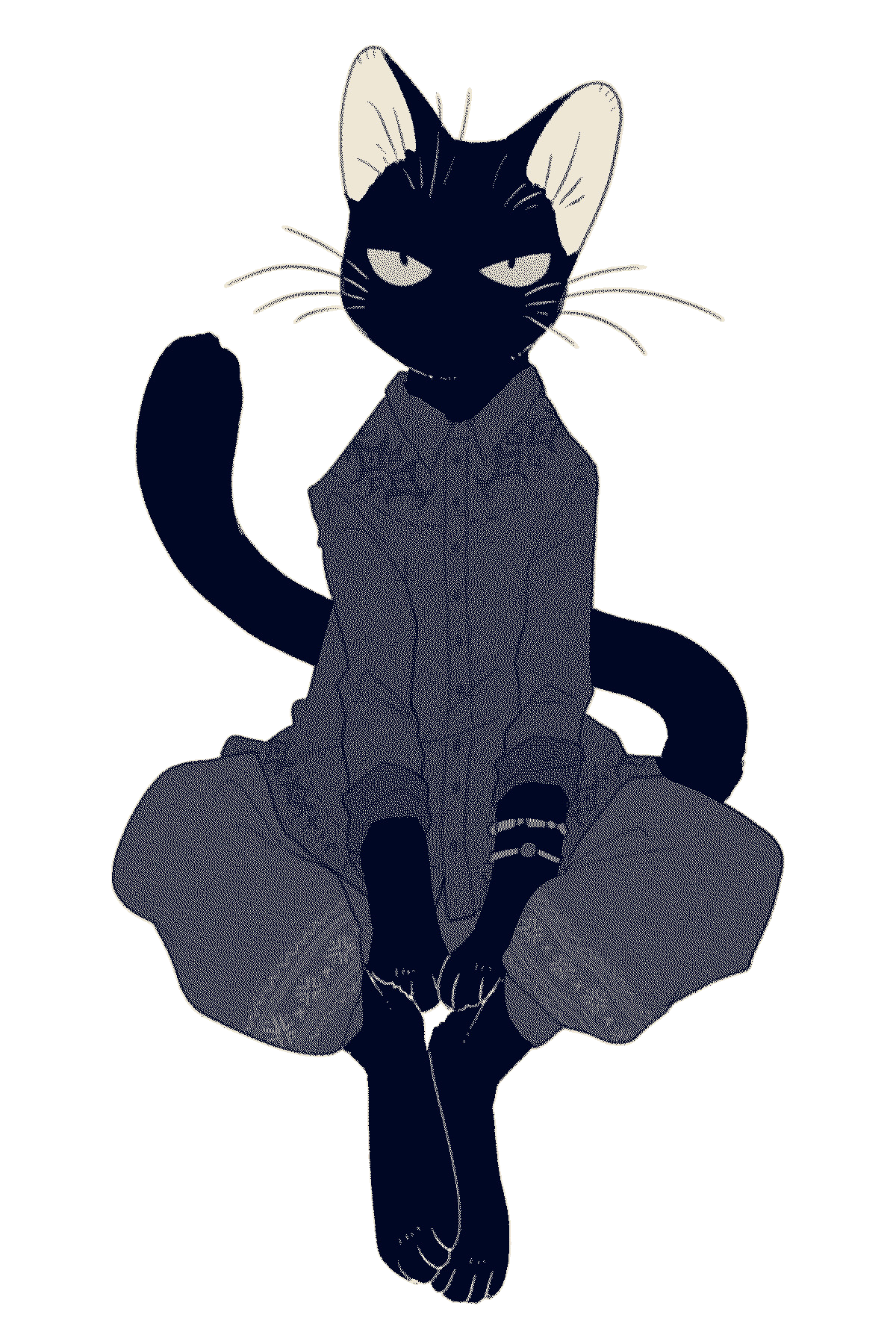
I’m a lover, not a fighter. But I still have the body of a predator! Since the dawn of man, humans have lived to die another day thanks to the ability to spot predators; out of the corner of your eye, or in the dark of night, or even if you didn’t consciously realize you did but quickly fled in response to a sudden and inexplicable pang of dread. The need for such constant hypervigilance may have fallen into disuse in our modern society, but deep instincts never go. Not how we like to pretend they do, anyways. Trust me, you’ll see me. You’d be damned not to. Especially at night! My fur is jet black, so I keep myself safe at night by wearing reflective clothes when I go out.
You may be surprised to hear that this is even less of an issue in heavy crowds. You’ve likely never noticed since you don’t view crowds from such a short height, but there’s much more room in between peoples legs then their arms, giving me plenty of room to squeeze in between everyone. Pair this with the fact that heavy crowds typically move slowly and decisively, and I’ve never had to worry too much about running an errand at five o’clock. If you feel something brush past your legs, it was probably me. I promise I didn’t look up your skirt.
All jokes aside, it’s difficult to describe how it feels to occupy a crowd from this angle... You see it a bunch in movies and TV, but never in person. Never all around you. You’d think I’d have to focus hard not to trip anyone, but I often find that the opposite happens; each pair of legs walking their own unique cycle, all overlapping and intersecting, coming together to form this moving forest that houses no creature other than the people they hold up and transport... it tends to lull me into this untroubled state where I forget everything. Only when I drift to where the crowd thins out do I remember that I’m apart of the forest as well, and that I have somewhere to be just like everyone else. And that I’m late.
—————
People ask me plenty if I like walking on two legs, and to this day I can never come up with a simple answer; it’s true that I like it, it’s not untrue that I don’t like it… I have something of a relationship with it, and it’s a fucking complicated one for sure.
It’s not like it’s only useful for seeing eye to eye with everyone else. Off the top of my head, I get to carry things while walking, help others move heavy objects, cook, clean, dance… There used to be so much more I could think of back when I was still in gait training, when they made me a whole list of all the things you get to do when you're bipedal, and I could’ve listed each one of them off memory. Now it’s been automatic to me for so long that most of those benefits are too obvious and basic to come up when I search my mind for them. Yeah, it’s good. Really good. But all the gait training and practice in the world won’t change the fact that this simply is not what my body is built for. Similar to how you can only sit at a computer for so many years before your body begins feeling crumpled up, I can only walk like this for so many years before my body feels stretched thin.
And it's already begun.
I was seventeen when I first felt it; I was pacing upright while taking a phone call when I felt a slight sting in my lower back. I work out all the time, I thought, it could be anything. It wasn’t until the third time I felt it a couple weeks later that I realized it wasn’t like any post workout ache I’d felt before, and it wasn’t until the fourth time, three days later, when I noticed that it vanished in seconds when I went on all fours and reappeared just as fast when I got back on two.
That’s how I first met Kastman. He was the only chiropractor at that time who was up to the task of putting aside his own work and responsibilities to conduct comprehensive research on my body and lifestyle (He nervously told me, after almost a year of knowing each other, that he was also training to be a pet chiropractic at the time and hadn’t mentioned it because he was too shy to express his profound love of cats to my face. It was adorable... he always has been). I’d had several adjustments before, but I never made the effort to consistently fit them into my schedule until then. He wrapped his arms around me and cracked out a tinge of discomfort, gifting me with an hour or two of relief from an irk I never realized I had until it was gone... I think I was still purring throughout his entire debrief.
“Your lower spine is being compressed,” He informed me, his valiant battle against sleep deprivation crystal clear in his eyes but undetectable in his voice, composed yet loud. “and I think we both saw this coming. But we have no collective knowledge to work with other than normal cats, so the real questions here are how long you can walk upright before it gets worse, and how much worse it can get, and what we can do about it if it gets worse, and what we can do about it right now.
“For starters, from now on I want you to jot it down in your phone whenever you feel pain in your lower back, preferably with as much detail as possible, where you are, what you're doing, what time it is, so on and so forth. I know you're busy and I know that’s not going to be intuitive, but all I ask is that you keep a record of when and where it happens. If we recognize any patterns, it could give us a better idea of what we can do.
“Next, I want you to work on not standing upright unless you absolutely have to. Sit down somewhere, hold yourself up with something, or just find a way to make it work on all fours, as long as your back isn’t holding your body up all by itself. And I know that’s easier said than done, okay? You’ve been doing this for years and you don’t do it consciously anymore, but we need to work on it. For now, one idea I have is some kind of device that vibrates or chimes, alerts you, when it detects that you’ve gone bipedal. Anything to help you get in the habit of making it more deliberate. Do you know somewhere you can get that? You do? Good.
“You already do yoga, correct? I also want you to put a heavier emphasis on stretches that are good for decompression...” He started writing in one of those little notebooks he’s always got in his pocket, “Now... I want you to do your normal routine...” and ripped me off a page. “And these stretches as well, okay? And I’d like you to hold them for at least one minute each.” I skimmed through the list, written in his messy yet elegant handwriting—FISH POSE, COBRA POSE, CAMEL POSE, PIRIFORMIS STRETCH, CAT-COW—and put it away without finishing it, feeling bitter that my to-do list wasn’t fat enough apparently. I guess he could see it on my face.
“I know you’re not gonna be happy about it, Citizen. You don’t have to incorporate it all at once, just take it one day at a time. And of course, you don’t strictly have to do them during yoga sessions, just when you have some spare time,” Yeah. Whenever that’s gonna be. “Remember, we’re thinking about the long term here. Right now all you really need to do is make small changes to your lifestyle. Which brings me to my last point.
“I know I already told you about only standing on two legs when necessary, but if you want you could also take longer breaks from it in general, right? I’m talking full on hiatuses from walking on two legs. You were able to go without it for the first ten years of your life, It’s certainly possible. This ties more into the long-term as well, because it’s not bad enough now to where you would need to take a hiatus from it entirely, but I think it would be a good way to practice it. Find ways to live your life strictly as a quadrupedal creature so you already know how to go about it by the time you're in your 30’s and 40’s, or whenever it gets bad enough.”
I liked that idea. Looking back, I realize that I envisioned a hiatus from two legs the way I would a vacation... It’s kind of funny. I went from loathing the very idea of walking hind legged as a child to slowly incorporating it as a given of my life, like breathing and eating. Nowadays I sometimes find myself wondering if I’d even be so much as inconvenienced if I never stood erect again; it’s not like anyone would bark at me for it. Not anyone I’d keep around, anyways.
“I think that’s about it for now,” It was the first and last session he didn’t end off by asking if I had any questions, probably because he was on the verge of falling asleep standing up. “I want you to come back next month for another adjustment,”
That was some years ago, and I’ve only missed a handful of sessions since then. I’ve got one tomorrow, actually. My back's been particularly sore this past week, so he’s getting me in early. As I’m writing this, I’m enjoying another hiatus from two legs. But eventually it won’t be enough; one day I’ll walk on two legs for the last time... I’m grateful that I get to do it, but I think I’ll also be grateful when I don’t get to anymore. I’m already kind of looking forward to that.
—————
Wordcount: 7,164
.png)
.png)